
Fiat video
Updated 13 Jul 2025
Fiat's story: the Italian giant that put a nation on wheels
Fiat. For many, the name is synonymous with small, charming city cars, Italian design and a hint of "La Dolce Vita", the sweet life. But Fiat's story is much more than that. It's the tale of an industrial giant that didn't just build cars, but motorised an entire nation, defined Italian culture, and stretched its tentacles into everything from aircraft and tractors to newspapers and football clubs. This is the story of Fabbrica Italiana Automobili Torino.
The beginning: Fabbrica Italiana Automobili Torino
We have to go back to 11 July 1899. In Turin, a city that would become Italy's answer to Detroit, a group of wealthy investors, including Giovanni Agnelli, gathered to found a new company. The name became Fabbrica Italiana Automobili Torino, which was quickly shortened to the catchier acronym: FIAT. The vision was clear: to build cars for the new century.
The founding in 1899 and the first car
That same year, the first car, the Fiat 4 HP (also known as the 3½ CV), rolled out of the humble factory. With a two cylinder engine and a top speed of around 35 km/h, it was a technological marvel for its time. Only 24 examples were ever built, but the start had been made. Fiat quickly proved its worth, not just on the street, but also on the racetrack, where the early models won several races and built a reputation for toughness and speed.
Lingotto: the factory with a racetrack on the roof
Fiat's ambitions grew explosively. In 1923 they opened a factory so revolutionary that it has become an architectural icon in its own right: the Lingotto factory. It was Europe's largest and most modern car factory, designed with a brilliant production logic. Raw materials entered at the bottom of the five-storey building. Production moved upward, floor by floor, until the finished cars arrived at the top. And what was at the top? A fully functional test track on the roof! Here every single new car was test driven before being sent down to street level and out to customers. Lingotto was a symbol of Italian innovation and a monument to the future of industry.
The people's car: the Topolino and the new 500
While the early cars were reserved for the wealthy, Fiat's true calling was building cars for the masses. In a time of political unrest and economic uncertainty in 1930s Italy, Fiat managed to create a masterpiece of minimalism.
Fiat 500 "Topolino": Italy's first people's car
In 1936 came the Fiat 500, which quickly earned the nickname "Topolino" (the Italian name for Mickey Mouse) due to its cute look with its big headlights. It was a small, cheap and extremely economical car that let ordinary Italian families own a car for the first time. The Topolino was more than a car, it was a symbol of freedom and progress, laying the foundation for Italy's motorisation.
Fiat Nuova 500: an immortal icon is born
After the Second World War, Italy lay in ruins, but an economic miracle was on the way. The country needed rebuilding, and people needed mobility. Fiat's answer came in 1957 and became one of the most iconic car designs ever: the Fiat Nuova 500. This new 500 was even smaller than the Topolino, designed to squeeze through the narrow, busy streets of Italian cities. With its rear engine and charming design, it became an instant phenomenon. It was the symbol of rebirth, optimism and the Italian lifestyle. From Rome to Milan, the streets were filled with the little humming car. The Fiat 500 isn't just a car, it's a piece of world culture, standing side by side with the Vespa scooter as an icon of Italy.
"Made in Italy": design, genius and growth
Fiat's success was largely driven by a series of brilliant engineers and designers who understood how to combine practical functionality with elegant design.
Dante Giacosa: the man behind the icons
No one embodies Fiat's design philosophy better than Dante Giacosa. He was the engineer and designer behind both the Topolino and the Nuova 500. His genius lay in creating maximum space and usability on a minimal footprint. He was a master of "form follows function", but always managed to add a touch of Italian elegance. His work defined Fiat for decades and inspired car manufacturers worldwide.
Fiat Panda: the genius box on wheels
In 1980, Fiat launched another stroke of genius that redefined the small, practical car: the Fiat Panda. Designed by the legendary Giorgetto Giugiaro, the Panda was a "box on wheels" in the most positive sense. Everything unnecessary had been stripped away. The seats could fold flat into a bed, the ashtray could slide along the dashboard, and its simple, robust mechanics made it almost impossible to kill. The Panda was pure, unfiltered functionality with an irresistible charm.
An industrial empire: when Fiat united Italy
Under the leadership of the Agnelli family, especially the charismatic Gianni Agnelli, Fiat grew from a car manufacturer into a giant industrial conglomerate. They had a hand in nearly every corner of Italian society.
The acquisitions: Lancia, Ferrari, Alfa Romeo and Maserati
From the late 1960s, Fiat began acquiring other major Italian car brands. Lancia and Ferrari came under the Fiat umbrella in 1969. Alfa Romeo followed in 1986 and Maserati in 1993. Fiat thus gathered the most prestigious and legendary names in the Italian car industry under one roof. This ensured the survival of many of the brands and cemented Fiat's position as an undisputed powerhouse.
The Agnelli family: Italy's uncrowned royal family
For decades, the Agnelli family and Fiat were almost synonymous. Gianni Agnelli wasn't just an industrial magnate, he was a style icon, a playboy and one of the most powerful men in Italy. The family also owned the football club Juventus, the newspaper La Stampa, and had interests in everything from construction to finance. Understanding Fiat's history means understanding the Agnelli family's enormous influence on modern Italy.
From crisis to global player: Marchionne and Chrysler
At the turn of the millennium, Fiat found itself in a deep crisis. The models were outdated, quality was inconsistent, and the debt was enormous. The giant was on its knees, and many feared for the brand's survival.
The relaunch of the Fiat 500 and the alliance with Chrysler
Salvation came in the form of the visionary CEO Sergio Marchionne. He carried out a brutal but necessary turnaround. The crowning achievement was the relaunch of the Fiat 500 in 2007, exactly 50 years after the original. The new 500 became an overwhelming success, its retro design and modern technology reviving the brand's soul. Marchionne didn't stop there. In the wake of the 2009 financial crisis, he orchestrated a bold alliance with the struggling American car manufacturer Chrysler. This created a new, global company: Fiat Chrysler Automobiles (FCA), transforming Fiat from a primarily European player into a global giant.
The models at a glance
| Model | Year | Note |
|---|---|---|
| 4 HP | 1899 | First Fiat, two cylinder engine, top speed around 35 km/h, 24 built |
| 500 Topolino | 1936 | Italy's first people's car, drawn by Dante Giacosa |
| Nuova 500 | 1957 | Rear engine and even smaller than the Topolino |
| Panda | 1980 | Box on wheels, designed by Giorgetto Giugiaro |
| 500 | 2007 | Relaunched with retro design, 50 years after the original |
Fiat today: part of Stellantis
In 2021, Fiat took another historic step by merging with the French PSA group (Peugeot, Citroën). The result is Stellantis, one of the world's largest car companies. For Fiat, this means access to new technologies and platforms, especially in electrification.
The future is electric: the new Fiat 500e
A perfect example of the new direction is the fully electric Fiat 500e. It builds on the success of the retro model, but is designed from the ground up as an electric car. It shows that Fiat still masters the art of creating charming, stylish and relevant city cars for a new era.
Watch Fiat in action: a world of Fiat videos
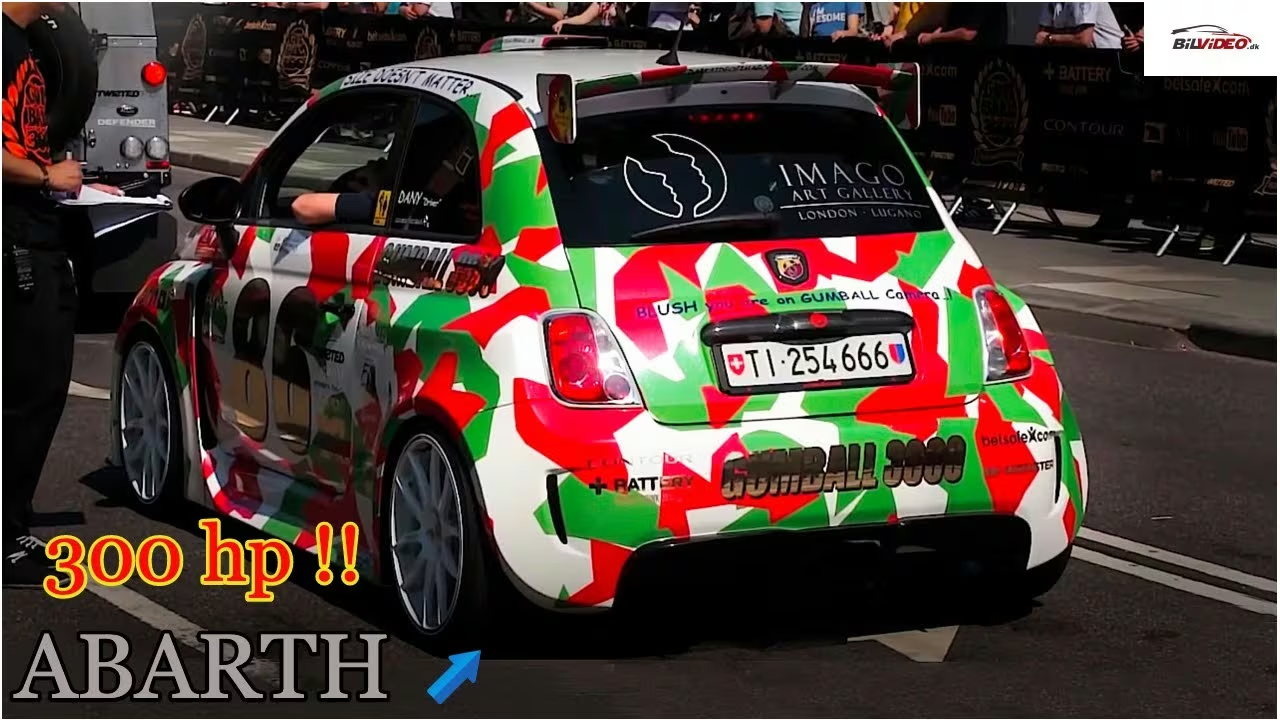
You can't talk about Fiat without highlighting the charm best experienced in motion. A well-edited Fiat video showing a classic 500 on the Amalfi Coast or a fiery Abarth (Fiat's performance brand) on a winding mountain road captures the essence of the brand. Here at Bilvideo.dk we celebrate exactly this kind of visual storytelling that brings car history to life.
Frequently asked questions about Fiat's history
What does Fiat stand for?
Fiat is an acronym for Fabbrica Italiana Automobili Torino, meaning "Italian Car Factory in Turin".
Where is Fiat from?
Fiat was founded and is headquartered in the city of Turin in northern Italy. The city is the centre of the Italian car industry.
Who owns Fiat today?
The Fiat brand is today part of Stellantis, a multinational car company formed in 2021 through a merger between Fiat Chrysler Automobiles (FCA) and the French PSA group.
What is the most famous Fiat model?
Without a doubt, the Fiat 500. Both the original "Nuova 500" from 1957 and the modern retro version from 2007 are global icons representing Italian design and culture.