
Ford video
Updated 13 Jul 2025

Ford's story: the man, the assembly line and the car that changed the world
Few names have shaped the 20th century as decisively as Ford. This isn't just the story of a car brand, it's the story of an industrial revolution, the birth of the middle class, and a stubborn visionary who set out to make the car accessible to everyone. From the simple genius of the Model T to the wild freedom of the Mustang and the legendary battle against Ferrari at Le Mans, Ford's story is an epic drama of innovation, ambition and American culture.
Henry Ford: a visionary mechanic with a dream
At the core of Ford's story is one man: Henry Ford. He was born in 1863 on a farm in Michigan, but from an early age was more interested in machines than farming. As a young man he worked as an engineer for the Edison Illuminating Company, but in his spare time he secretly worked on his own petrol-powered vehicle. In 1896, his first vehicle, the Ford Quadricycle, was finished. It was a flimsy contraption on four bicycle wheels, but it worked. The dream was lit.
The early years and failed attempts
The road to success wasn't easy. Henry Ford's first company, the Detroit Automobile Company, went bankrupt. He left his second attempt, the Henry Ford Company, in anger after disagreements with the investors (it later became Cadillac). But Ford was stubborn. He was convinced the future lay in building a simple, reliable and cheap car for the ordinary man, not luxurious vehicles for the wealthy.
The founding of Ford Motor Company in 1903
In 1903, it finally worked. With an investment of 28,000 dollars from 12 different investors, Ford Motor Company was founded. The first car, the Model A, was sold shortly after, and this time it was a breakthrough. The company was profitable from the very start, but Henry Ford's real revolution was just around the corner.
The revolution: the Model T and the assembly line
In 1908, Ford introduced a car that would change everything: the Model T. It was the culmination of Henry Ford's vision. The car was extremely simple, easy to repair and rugged enough for the terrible roads of the time. It was an instant success, but the enormous demand created a new challenge: how could you build the cars fast enough and cheaply enough?
The assembly line: more than just a production line
The answer came in 1913 with the introduction of the moving assembly line in car production. The idea wasn't Ford's own, but he perfected it into an art form. Instead of workers moving around a stationary car, the car was now moved past the workers, with each man performing a single, specialised task.
The result was revolutionary. Assembly time for a Model T dropped from over 12 hours to just 93 minutes. The price plunged from 850 dollars in 1908 to under 300 dollars in the 1920s. Suddenly the car was no longer a luxury good, it was within economic reach for millions of people. The Model T didn't just put America on wheels, it created a new kind of freedom and mobility and laid the foundation for the suburbs and the modern lifestyle.
"$5-a-day": a social and economic experiment
Henry Ford understood that his own workers also needed to be able to afford the cars they were producing. In 1914 he shocked the world by more than doubling the average daily wage to five dollars a day. It was a brilliant move. It reduced the enormous staff turnover at the factory, created a loyal workforce, and boosted the economy by creating a new, well-paid customer base.
The interwar years and new icons
After 19 years and more than 15 million units produced, production of the Model T stopped in 1927. It was replaced by the more modern Model A. But perhaps the most important innovation of the 1930s was the introduction of the mass-produced V8 engine in 1932. It gave ordinary cars power and performance previously reserved for expensive luxury brands, and it became an icon of American car culture.
During the Second World War, Ford, like the rest of the industry, converted its production to the war effort and became part of what was called the "Arsenal of Democracy", producing everything from bombers and jeeps to tanks.
The battle for prestige: Ford vs. Ferrari at Le Mans
By the 1960s, Ford was an industrial giant, but they lacked prestige in the international world of motorsport, which was dominated by European brands like Ferrari. Henry Ford II, Henry Ford's grandson, decided to change that by buying Ferrari.
A deal that fell through
A deal was nearly in place in 1963, but at the last minute Enzo Ferrari pulled out with an insulting remark aimed at Henry Ford II. Furious and humiliated, Ford gave his engineers a simple message: "Go to Le Mans, and beat his ass."
The creation of the Ford GT40: a legend is born
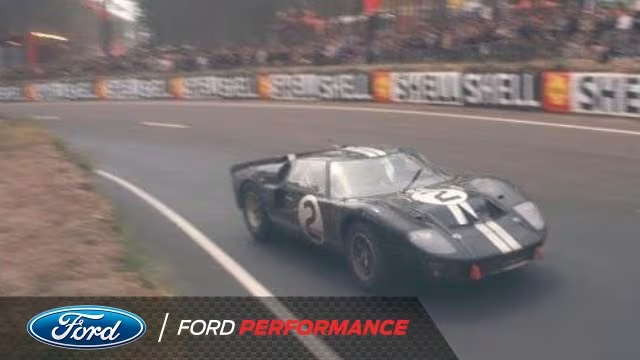
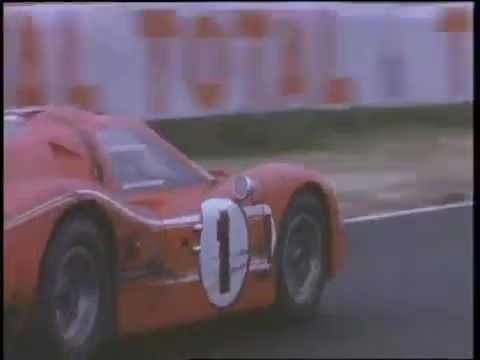
The mission was clear: build a car that could beat Ferrari in the world's most prestigious race, the 24 Hours of Le Mans. The result was the legendary Ford GT40. The name came from the car's purpose (Grand Touring) and its height (only 40 inches). The car was a technological tour de force, powered by a massive American V8 engine. The first years were marked by failures and technical problems, but the team, led by Carroll Shelby and Ken Miles, didn't give up.
The 1966 victory: a historic moment
In 1966, it finally happened. The Ford GT40 humiliated Ferrari by taking 1st, 2nd and 3rd place at Le Mans. It was one of the greatest triumphs in motorsport history and proof of American willpower and engineering. Ford repeated the win in 1967, 1968 and 1969, cementing the GT40's place as one of the most iconic racing cars ever.
Ford video with the three Ford GT40s:
Icons of the road: the Mustang and European success
While the GT40 conquered the racetracks, in 1964 Ford launched a car that would conquer the streets and the hearts of an entire generation: the Ford Mustang. It was smart, sporty and available at an affordable price. It created its very own car class, "the pony car", and became a symbol of 1960s youth culture and dreams of freedom.
At the same time, Ford achieved enormous success in Europe with models tailored to the local market. Cars like the Ford Cortina, Escort and Capri became household names and dominated the sales charts for decades.
Modern times: global platforms and an electric future
In recent decades, Ford has navigated a globalised world with strategies like "One Ford", which aimed to create global models for every market, such as the Ford Focus. In the USA, the gigantic F-150 pickup truck has for decades been the best-selling vehicle of all time and forms the backbone of the company's economy.
A new revolution: the Mustang Mach-E and electrification
Today, like the rest of the car industry, Ford faces its biggest upheaval since the assembly line: the shift to electric cars. With the launch of the fully electric Mustang Mach-E, Ford has signalled that they're taking the future seriously. By using their most iconic name for an electric car, they're showing that electrification doesn't have to be boring, but can carry the same passion and performance that has defined the brand for generations.
Experience Ford's legacy: a world of Ford videos
Ford's story is filled with sound and motion. From the quiet hum of a Model T to the deafening roar of a GT40 at Le Mans. Watching a Ford video is the best way to experience the legacy. Here at Bilvideo.dk you can find clips that bring the history to life and show why Ford remains one of the world's most significant car manufacturers.
Ford's history by year
| Year | Milestone | Note |
|---|---|---|
| 1896 | Ford Quadricycle | Henry Ford's first vehicle, four bicycle wheels |
| 1903 | Ford Motor Company founded | 28,000 dollars from 12 investors |
| 1908 | Model T introduced | The price was 850 dollars at launch |
| 1913 | The moving assembly line | Assembly time from over 12 hours to 93 minutes |
| 1914 | Five dollars a day | The daily wage was more than doubled |
| 1927 | Model T production ends | More than 15 million units in 19 years |
| 1932 | Mass-produced V8 engine | Power for ordinary cars |
| 1964 | Ford Mustang | Created the pony car class |
| 1966 | Ford GT40 wins Le Mans | 1st, 2nd and 3rd place, repeated in 1967, 1968 and 1969 |
Frequently asked questions about Ford's history
Who founded Ford?
Ford Motor Company was founded by Henry Ford in Detroit, Michigan, on 16 June 1903.
What was the first Ford car?
The first car produced by Ford Motor Company was the Ford Model A in 1903. However, Henry Ford's very first personal vehicle was the Ford Quadricycle from 1896.
Why was the Model T so important?
The Model T was revolutionary because, thanks to the moving assembly line, it became the first car an ordinary worker could afford. It changed society by making mobility accessible to the masses.
Why did Ford build the GT40?
Ford built the GT40 with a specific purpose: to beat Ferrari at the 24 Hours of Le Mans, after an acquisition deal between the two companies collapsed dramatically.