
Pagani video
Updated 13 Jul 2025
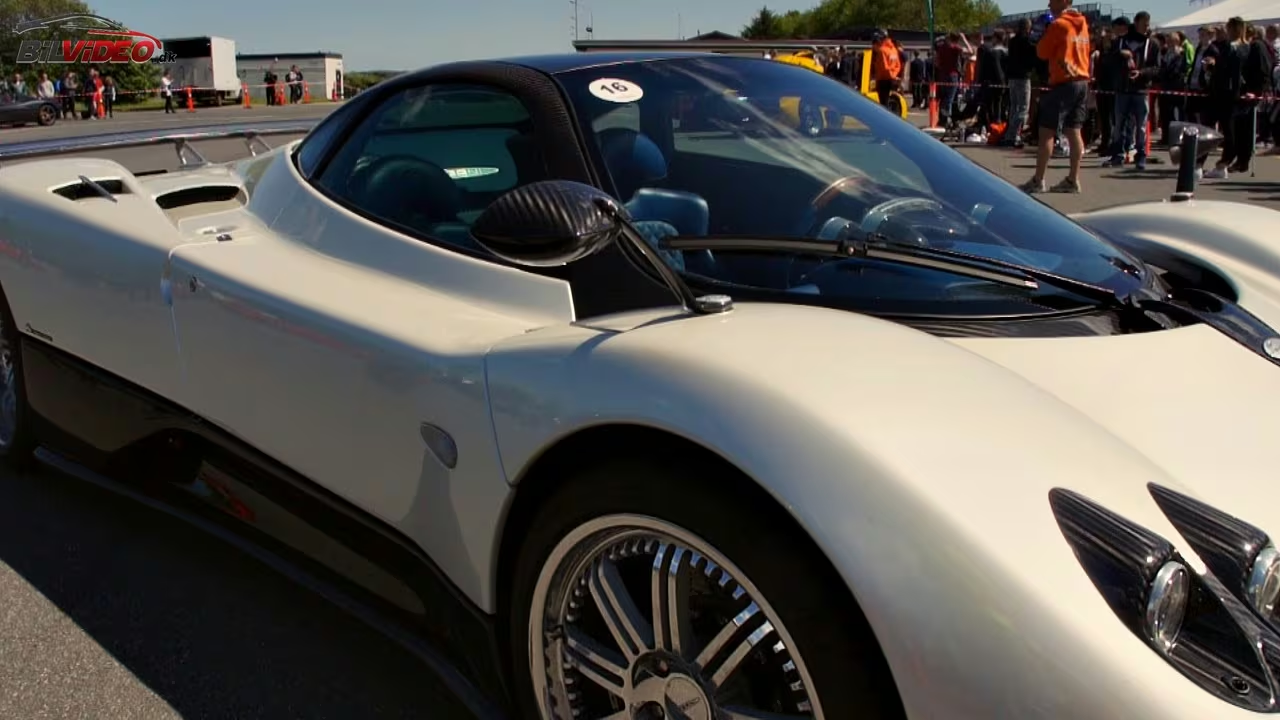
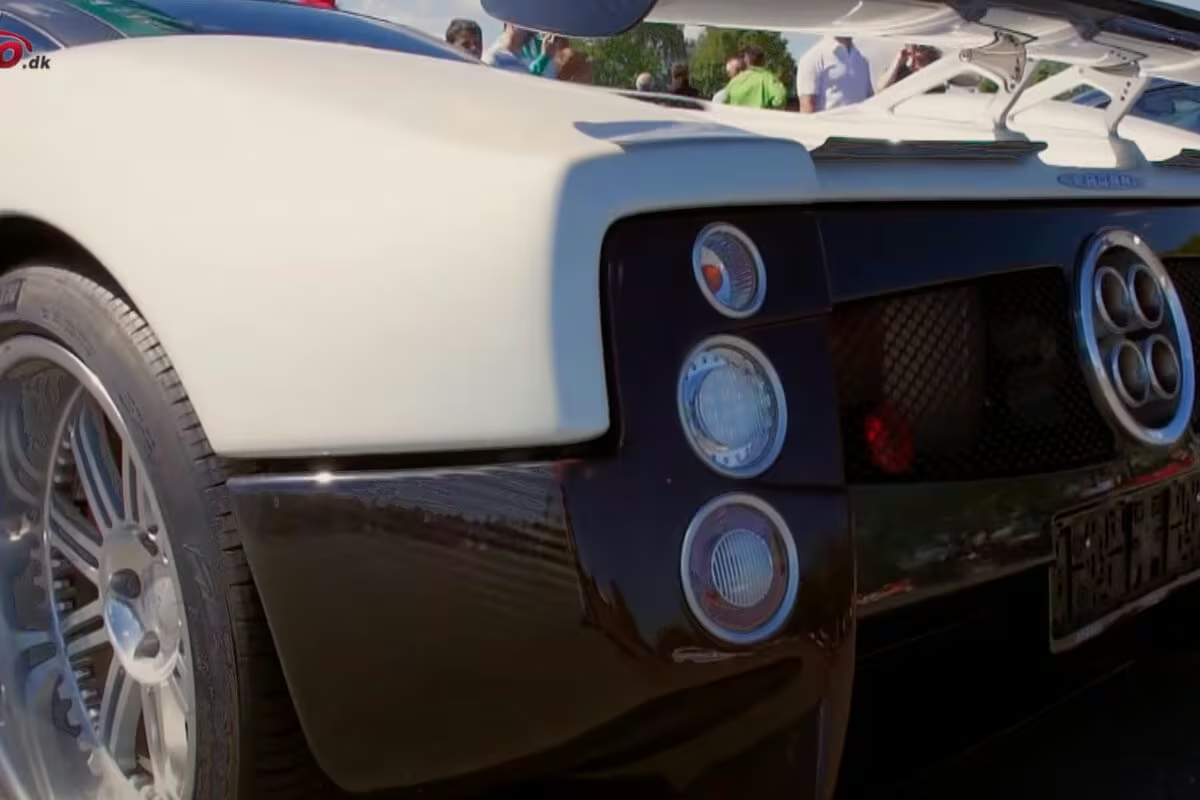
Pagani's story: the dream of the perfect supercar
In a world of car industry giants with over a hundred years of history, there's a small, almost sacred place in the Italian town of San Cesario sul Panaro. From here come cars so exquisite, so detailed and so uncompromising that they blur the line between car and work of art. This is Pagani's story. It's not a tale of mass production, but of one man's obsession with perfection, a deep understanding of materials and an unshakeable belief in Leonardo da Vinci's philosophy: that art and science can, and should, go hand in hand.
The man behind the masterpiece: who is Horacio Pagani?
To understand Pagani's cars, you first have to understand the man who dreamed them into being: Horacio Pagani. His story is just as remarkable as his creations.
A childhood dream in Argentina
Horacio Pagani was born in 1955 in Casilda, Argentina, into a family with Italian roots. His father was a baker, but young Horacio was obsessed with cars. He spent his childhood designing and building small model cars out of balsa wood, already showing an incredible sense of form and detail as a child. He dreamed of moving to Modena in Italy, the heart of supercar country, to design his own cars.
The road to Italy and his apprenticeship at Lamborghini
Driven by his dream and a letter of recommendation from his hero, the legendary Formula 1 world champion Juan Manuel Fangio, a young Horacio Pagani moved to Italy in the early 1980s. With little money in his pocket, he got a job at Lamborghini, where he started out sweeping floors. His talent and work ethic were quickly noticed, however, and he rose through the ranks to become chief engineer.
The pioneer of carbon fibre
At Lamborghini, Horacio Pagani became fascinated with new, lightweight materials. He saw enormous potential in carbon fibre and tried to convince Lamborghini's management to invest in an autoclave (a special oven for curing composite materials). When they refused, he took out a personal loan and bought his own. In 1988 he founded Pagani Composite Research, which helped Lamborghini develop the revolutionary Countach Evoluzione, a prototype built almost entirely from carbon fibre. He was now one of the world's leading experts in the material, but the dream of his own car lived on.
The birth of a legend: the Pagani Zonda
In 1991, Horacio Pagani left Lamborghini to pursue his lifelong dream. He founded Modena Design and began working on his own supercar project, known internally as "C8".
Project "C8" and the deal with Mercedes-AMG
Pagani knew the heart of his car had to be something truly special. Through his friendship with Juan Manuel Fangio, he established contact with Mercedes-Benz. It resulted in a historic deal: Mercedes' performance division, AMG, would develop and supply a bespoke V12 engine for Pagani's new car. The car was originally supposed to be called "Fangio F1" as a tribute to his friend and mentor, but after Fangio's death in 1995, Horacio Pagani decided, out of respect, that the name was too big to carry. Instead he chose Zonda, named after a powerful wind in the Argentine Andes.
Zonda C12: the shock at Geneva 1999
At the Geneva Motor Show in 1999, the world was presented with the Pagani Zonda C12 for the first time. The shock was total. No one had seen anything like it. The design was dramatic and organic, inspired by jet fighters and Mercedes' Le Mans racers. The central, four-pipe exhaust looked like a rocket nozzle and instantly became an iconic signature. The interior was an exquisite blend of polished aluminium, leather and exposed carbon fibre that set a whole new standard for craftsmanship in a supercar. The Zonda wasn't just a car, it was a statement.
The evolution: from the Zonda S to the extreme Zonda R
The Zonda C12 was only the beginning. Over the next decade, Pagani constantly developed the Zonda platform. The Zonda S came with a larger 7.0 litre engine. The Zonda F (for Fangio) in 2005 was an even more refined and powerful version. And then there was the Zonda R from 2009, a car built purely for the racetrack. It shared only 10% of its components with the road-legal Zondas and was a brutal expression of what was technologically possible when you ignored every rule.
The art and the science: what makes a Pagani special?
Calling a Pagani "expensive" misses the point. Every car is a hand-built masterpiece, where the price reflects an uncompromising approach to materials and detail.
The obsession with detail: every screw a jewel
Horacio Pagani is famous for his obsession with detail. Every single visible bolt and screw in a Pagani is made of titanium, specially designed and stamped with the Pagani logo. These screws alone cost a fortune. The leather for the interior comes from specially selected suppliers, and the fits are flawless. Even the way the carbon fibre weave lines up across different body panels is carefully planned to create a perfect visual pattern.
The master of carbon fibre and Carbotanium
Pagani's expertise in carbon fibre is unmatched. They were pioneers in the use of Carbotanium, a patented material that weaves titanium threads into the carbon fibre. The result is a material that's even stronger and more shatter resistant than traditional carbon fibre, providing maximum safety and stiffness at an extremely low weight.
The sound of the AMG V12 engine
The heart of every Pagani is the mighty, naturally aspirated V12 engine, hand built by a single technician at AMG in Germany. The partnership has ensured Pagani an engine that's not just monstrously powerful and reliable, but that also delivers a soundtrack that's a symphony of mechanical precision and raw power.
The successor: the Pagani Huayra, god of the winds
After more than a decade with the Zonda, it was time for a successor. In 2011, the Pagani Huayra was presented, named after Huayra-tata, a wind god from the Andes.
Seven years of development and active aerodynamics
The Huayra was the result of seven years of intense development. It was the first car in the world to use a fully active aerodynamic system. Four independent flaps on the car's front and rear constantly adjust themselves while driving to optimise downforce and minimise drag. It was a technological leap that once again put Pagani at the front of the field. The engine was now a bi-turbo V12 from AMG, delivering even more brutal torque.
Back to basics: the Pagani Utopia
In 2022, Pagani presented their third model: the Utopia. At a time when hybridisation and digitisation dominate, the Utopia was a deliberate step in a different direction.
A tribute to the analogue driving experience
The Utopia is a tribute to the pure, analogue driving experience. Gone are the big digital screens in the cabin, replaced by beautiful, analogue clocks. The focus is on light weight, simplicity and driver engagement. The engine is a new, even more powerful bi-turbo V12 from AMG, but the biggest news for enthusiasts was something else: the option of a manual gearbox. Pagani had built one of the world's most complex and beautiful manual gearboxes with an exposed mechanism, purely for the sake of the driving experience.
The models at a glance
| Model | Year | Note |
|---|---|---|
| Zonda C12 | 1999 | Debut at the Geneva Motor Show, V12 from AMG |
| Zonda F | 2005 | Named after Fangio, more refined and more powerful |
| Zonda R | 2009 | Pure track car, shared only 10% of its parts with the road cars |
| Huayra | 2011 | First car in the world with a fully active aerodynamic system |
| Utopia | 2022 | Analogue dials and the option of a manual gearbox |
Pagani in the flesh: a symphony of Pagani videos
Words and pictures can only describe a Pagani so far. To truly understand the magic, you have to see and hear it. A high quality Pagani video capturing the sound of the V12 engine accelerating through a mountain pass, or showing the active flaps in action, is the only way to get close to the real experience. Here at Bilvideo.dk we celebrate exactly these visual masterpieces.
Frequently asked questions about Pagani's history
Who founded Pagani?
Pagani Automobili S.p.A. was founded by Horacio Pagani, an Argentine-Italian engineer and designer with a past at Lamborghini.
Where is Pagani from?
Pagani is based in San Cesario sul Panaro, a small town near Modena in Italy, also known as "Motor Valley".
What engine does Pagani use?
Since the first Zonda, Pagani has used bespoke V12 engines developed and hand built by Mercedes-AMG in Germany.
Are Pagani cars worth the money?
Value is subjective, but a Pagani is considered an "investment piece" on par with fine art. The extreme quality, the limited numbers and the unique craftsmanship mean they often hold, or even increase, in value over time.