
Ultima video
Updated 13 Jul 2025
Ultima's story: the British supercar killer
Forget all about luxury, comfort and prestigious logos built up over 100 years of marketing. In a corner of Leicestershire, England, there's a small manufacturer whose only mission is to build the absolute fastest, road-legal cars on the planet, for a fraction of the price of an established supercar. This is the story of Ultima, a tale of uncompromising engineering, Le Mans-inspired design and a "do-it-yourself" philosophy that has let ordinary enthusiasts own a car with hyper car performance.
The start: from Lee Noble to the Marlow family
Ultima's story doesn't start with Ultima Sports Ltd, but with one of the most respected figures in the British specialist car industry: Lee Noble. In 1983 he founded Noble Motorsports Ltd and created the first Ultima, the Ultima Mk1. The car was heavily inspired by the potent Group C racers that dominated Le Mans in the 80s, and was built around a tubular spaceframe chassis and a V6 engine from a Renault.
After the first prototypes, the Mk1 and Mk2, the Mk3 was developed. These cars were primarily designed for the racetrack and achieved significant success in British racing series. In fact, the car's design was so effective that two examples were sold to McLaren, who used them as "mules", test cars, during the early development of their legendary F1 supercar. One of them was even fitted with the BMW V12 engine that later ended up in the F1.
A new era: Ultima Sports Ltd is founded
One of Lee Noble's customers and racing drivers was a man named Ted Marlow. He and his son, Richard Marlow, became so obsessed with the Ultima's potential that in 1992 they bought all the rights to the design from Lee Noble, who wanted to move on to other projects. Ultima Sports Ltd was born. The Marlow family's vision was different from Noble's. They wanted to transform the raw racing car into a car that could be built, registered and driven on public roads, without sacrificing its extreme performance.
The philosophy: the DIY hyper car
At the heart of Ultima's business model has always been "component form", or in plain terms: a kit. By selling the car in parts that the customer assembles themselves, Ultima could bypass the extremely expensive and time consuming type approvals required for mass produced cars. This kept the price dramatically low.
But even more importantly, it opened up a world of choices. Customers could choose and install their own engine and gearbox. An overwhelming number chose the engine Ultima has become synonymous with: the American Chevrolet V8 Small-Block. This engine was (and is) relatively cheap, extremely robust, and can be tuned to deliver enormous amounts of horsepower. Combined with a Porsche gearbox, it made up a nearly bulletproof drivetrain.
Ultima's stroke of genius was designing a chassis and build system so logical and well documented that a person with ordinary mechanical skills could assemble their own supercar in a home garage.
The icons: GTR and Can-Am
In 1999, Ultima launched the two models that would define the brand for nearly two decades and smash countless world records: the Ultima GTR (the coupe version) and the Ultima Can-Am (the open spyder version).
Ultima GTR: the world record machine
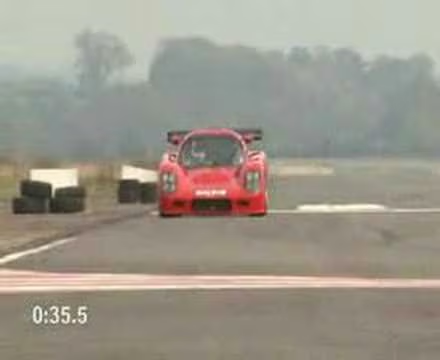
The GTR was a revelation. With its low, wide Le Mans look and a potent V8 engine that could deliver anywhere from 350 to over 1,000 hp, it was a performance monster. Since the car weighed under 1,000 kg, its power-to-weight ratio was completely insane.
Ultima was not shy about proving the GTR's capabilities. In the mid-2000s, with Richard Marlow behind the wheel, a GTR with a 720 hp Chevrolet V8 set a series of official world records for road cars, including:
- 0-100 km/h: 2.6 seconds
- 0-160 km/h: 5.3 seconds
- 0-160-0 km/h: 9.4 seconds (a test of both acceleration and braking)
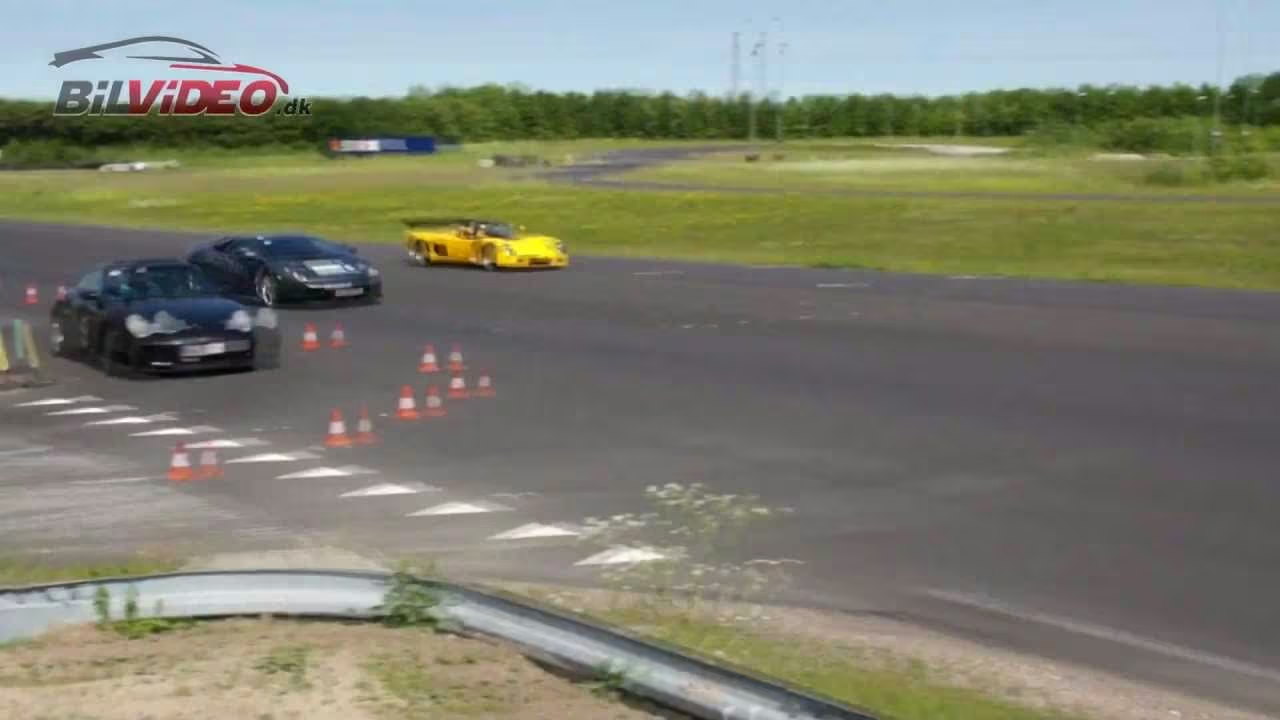
These times humbled pretty much everything established brands like Ferrari, Lamborghini and Porsche could manage at the time, including the mighty Bugatti Veyron on several parameters. The Ultima GTR became known as "the hypercar killer".
Ultima Can-Am: the open and even rawer experience
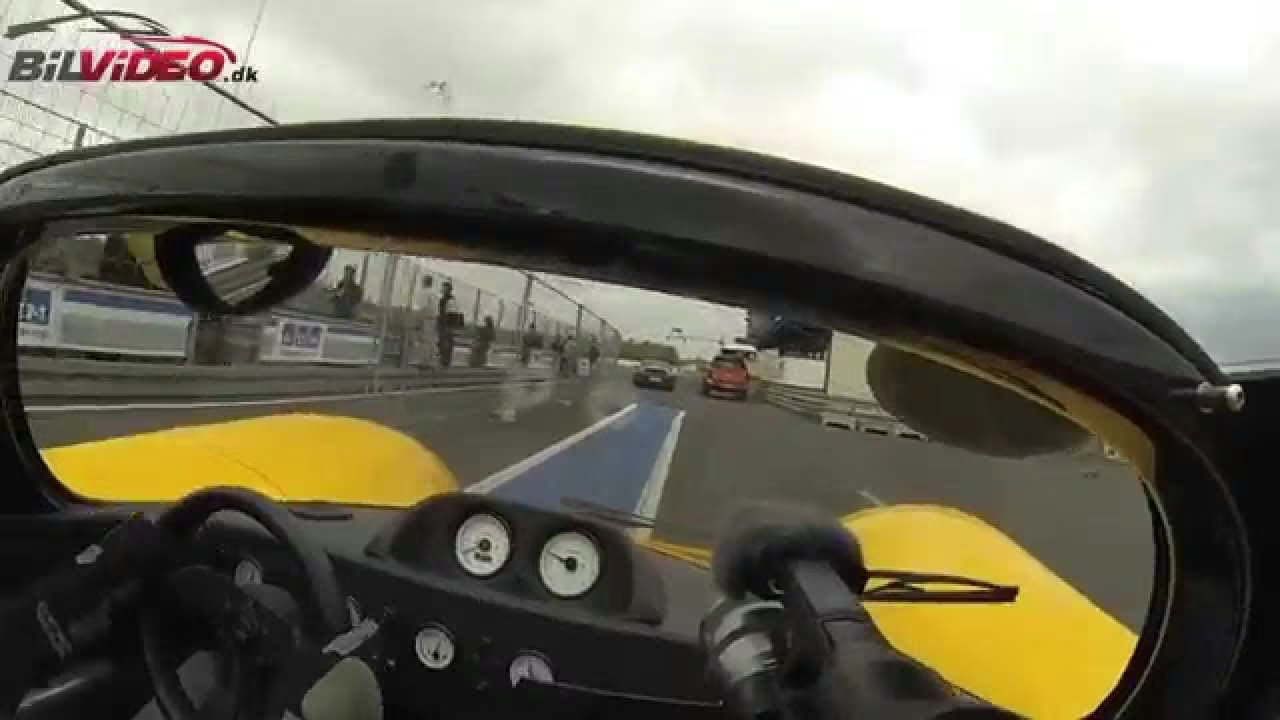
The Can-Am model shared its chassis and mechanics with the GTR but removed the roof for an even more intense, wind-blown driving experience. The name was a tribute to the legendary North American Can-Am racing series from the 60s and 70s, famous for its monster racers with unlimited engine power. The name suited the open Ultima perfectly, delivering one of the rawest, most unfiltered driving experiences money could buy.
Evolution and the new generation: Ultima RS
After many successful years with the GTR and Can-Am (which were updated to "Evolution" models in 2015), 2019 brought the next big revolution: the Ultima RS.
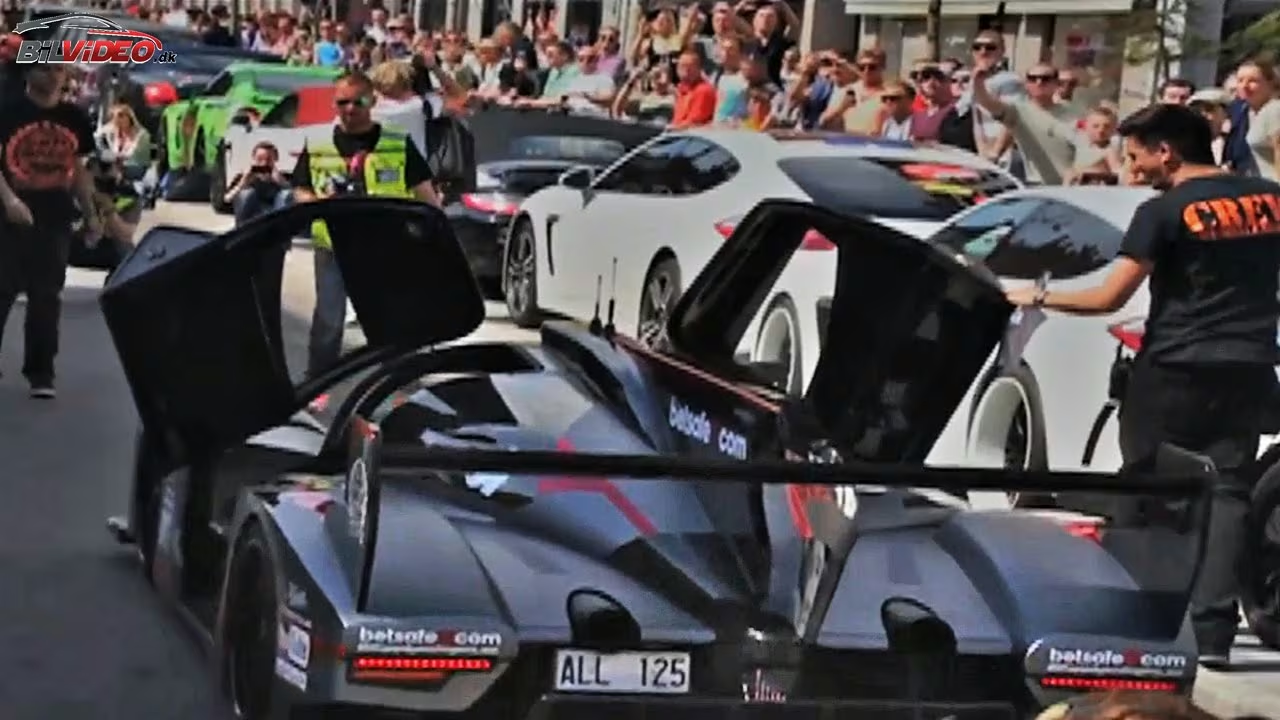
The RS is the culmination of 35 years of experience. Although it's unmistakably an Ultima, almost every component is new. The design has become sharper and more aerodynamic, drawing inspiration from modern LMP1 racers from Le Mans. It features advanced aerodynamics, such as a large carbon fibre rear wing and a front splitter that generates real downforce.
Modern technology, the same raw philosophy
Underneath, the philosophy is the same. The heart is still a Chevrolet V8, but now from the newest LS and LT generation. Customers can choose anything from a standard "base model" with 430 hp to an insane, supercharged LT5 engine with 1,200 hp. In a car weighing around 930 kg, that gives a power-to-weight ratio that surpasses even a Koenigsegg.
Although the car is more sophisticated, with options for modern conveniences like air conditioning, a navigation system and a rear view camera, the core is still the same: no ABS, no traction control, no electronic driver aids. It's a pure, unfiltered, analogue driving machine that demands the driver's full attention.
The models at a glance
| Model | Year | Note |
|---|---|---|
| Mk1 | 1983 | Lee Noble's first Ultima, tubular spaceframe and Renault V6 |
| GTR | 1999 | Coupe with a V8 from 350 to over 1,000 hp, weight under 1,000 kg |
| Can-Am | 1999 | Open spyder sharing the GTR's chassis and mechanicals |
| Evolution | 2015 | Updated versions of the GTR and the Can-Am |
| RS | 2019 | LMP1 inspired, from 430 hp to 1,200 hp, around 930 kg |
What makes Ultima unique?
- Performance per pound: No other car manufacturer in the world offers so much speed for the money. A self-built Ultima RS can deliver performance matching or exceeding a Bugatti Chiron, for less than the price of a new Porsche 911.
- The analogue experience: In a digital age, Ultima is a refuge for the purist enthusiast. The direct connection between driver, machine and road is almost without equal.
- The build process: For many owners, the build process itself is just as much a part of the experience as driving the car. Assembling your own supercar from the ground up gives a sense of pride and ownership that money can't buy.
Experience Ultima's brutality: a world of Ultima videos
You can't read your way to the feeling of an Ultima. The sound of the roaring V8, the visual shock of the acceleration and the raw mechanical sensation have to be seen and heard. An Ultima video is the only way to come close to understanding just how extreme this car really is. Here at Bilvideo.dk we celebrate these machines that dare to be different.
Frequently asked questions about Ultima's history
Who founded Ultima?
The original Ultima design was created by Lee Noble in 1983. The company as we know it today, Ultima Sports Ltd, was founded in 1992 by Ted and Richard Marlow, after they bought the rights from Noble.
Is Ultima a kit car?
Yes, Ultima is primarily known as a "kit car". This is the core of their business model, although in certain markets they can supply factory-built cars to order.
What engine does an Ultima use?
Ultima cars are designed to use various engines, but they're inextricably linked to the American Chevrolet V8 engine (both the older Small-Block generations and the newer LS/LT engines), paired with a Porsche manual gearbox.
How fast is an Ultima?
Extremely fast. The top model, the Ultima RS with a 1,200 hp engine, has a theoretical 0-100 km/h time of around 2.3 seconds and a top speed of over 400 km/h (limited by gearing). Even the base models are faster than most supercars on the market.